
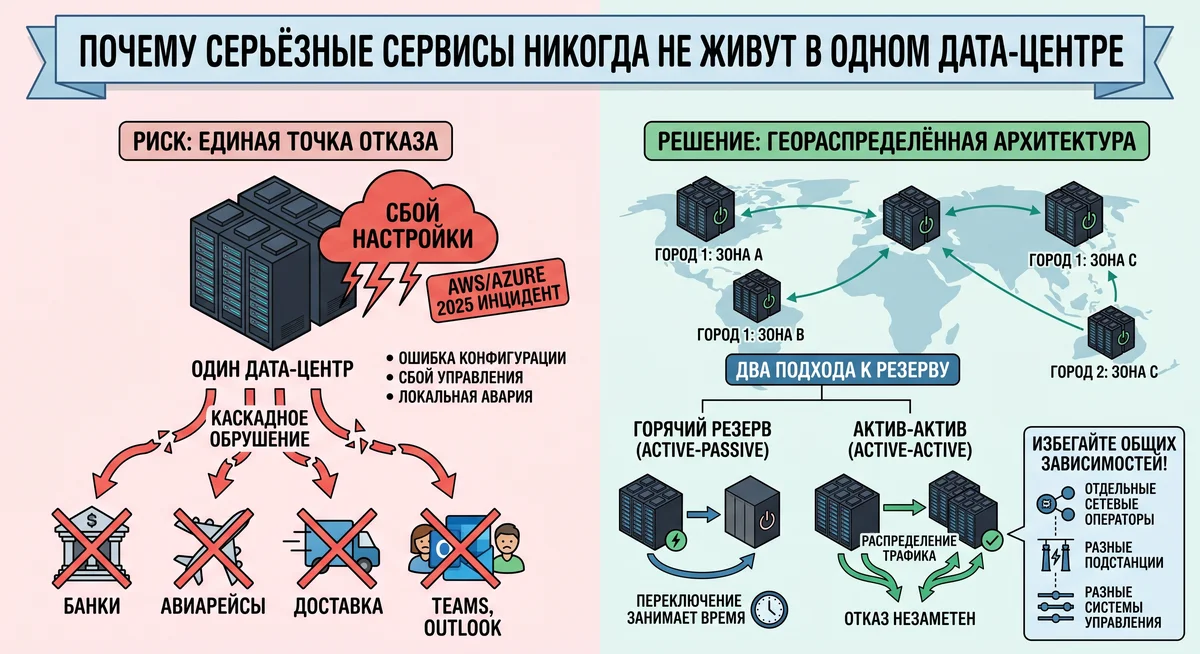
Last fall, the internet reminded everyone twice in ten days that “the cloud” is really just ordinary buildings full of servers. First, on October 20, 2025, a single AWS region failed in Northern Virginia — and over a hundred services around the world went down with it: delivery apps, banks, airline check-in systems. Less than nine days later, the same thing happened at Microsoft Azure: Teams, Outlook, Xbox, and entire airline check-in counters went dark. In both cases, the cause wasn’t hackers or a fire, but a single misconfiguration that cascaded and brought everything else down with it.
The takeaway is simple. A single data center is always a single point of failure, even if it’s built to the highest standard, with backup power and cooling. No uninterruptible power supply protects you from a configuration error or an outage that takes down an entire region. Engineers know how to build extremely reliable facilities, but absolute reliability doesn’t exist, and sooner or later that catches up with you.
That’s why serious projects don’t rely on a single site — they spread the load across several data centers. It starts with duplicating equipment within one hall, then spreading it across different buildings in the same city (these are called availability zones), and at the most critical level, across different cities and countries, so that no local incident can hit both sites at once.
How to connect the sites
The first approach: the primary site does the work, while the second sits in hot standby and takes over if the primary fails. This is cheaper, but the switchover takes time and needs to be tested regularly. A backup that has never been tested under load isn’t a backup — it’s just a hope. The second approach: both sites work simultaneously and split the traffic, so the loss of one goes almost unnoticed. More reliable, but noticeably more expensive.
The non-obvious part
A backup that shares a dependency with the primary site isn’t really a backup at all. That’s exactly what tripped up many companies last fall: servers sat in different regions, but relied on the same provider’s control plane — and once that failed, geography didn’t help. Sometimes it’s simpler: two sites fed by the same substation, or two channels from the same carrier. On paper it’s redundancy; in practice it’s a shared weak point dragging both sites down together.
The bottom line
Geo-distribution isn’t about playing it safe or piling up sites for the sake of appearances — it’s about sound math: understanding what an hour of downtime actually costs you, and investing in independence exactly as much as that’s worth. Real resilience comes down to two simple things: the sites must not share a single point of failure, and the failover between them should be tested ahead of time, in a calm moment — not in the middle of an actual outage.
The good news is that all of this is a matter of thoughtful architecture more than budget. And building it is entirely within reach, if you think about it in advance.
So how is this handled in your case — is your project still running on a single site, or are you already looking at a backup one?