
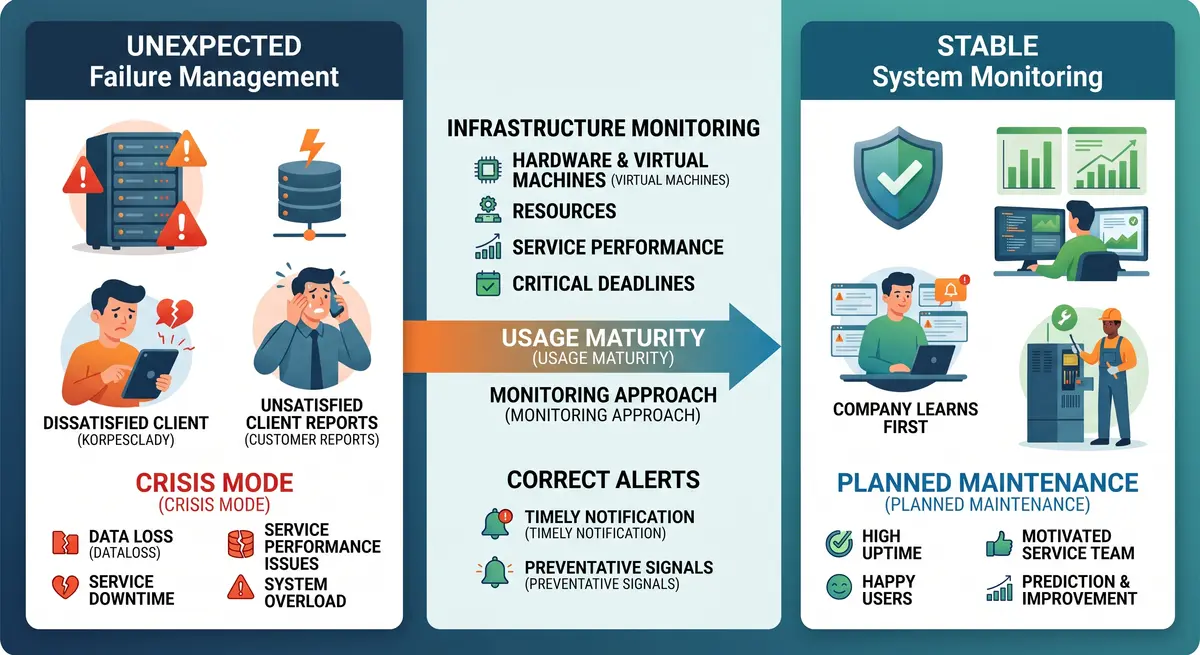
There are two ways to find out that a service is down. The first: a frustrated client informs you. The second: the company discovers it on its own, before anyone outside notices. The distance between these two scenarios defines the maturity of your operations — and monitoring is what closes it.
Despite how obvious the idea is, a significant share of companies operate by the first scenario. As long as the server is running, no one looks into its condition — until it fails. And when it does, it turns out that disk space had been filling up gradually over a week, available memory had been shrinking for months, and the certificate expired the day before. Every one of these events could have been seen coming.
What monitoring infrastructure actually means
Monitoring is not a person watching dashboards — it is an automated system that continuously checks key metrics and raises an alert when values move outside acceptable limits. Several layers are worth tracking. The availability of the hardware and virtual machines themselves. Resources — free disk space, memory, processor load. The health of application services — the website, database, mail — and their response speed. And, finally, approaching critical deadlines, such as the expiry of an SSL certificate or domain registration.
The value is in alerts, not charts
This is where a common mistake lies. Companies deploy a system with elegant panels and graphs — and then never look at it. Yet the point of monitoring is not the ability to observe a state, but the ability to notify the right people promptly when action is required. A properly configured alert — to a messenger, email, or phone call — matters far more than a visualization no one opens. The system must report a problem on its own, so the company is the first to know.
A higher level — warning before failure
Mature monitoring signals not a failure that has occurred, but one that is approaching. For example: at the current rate, disk space will be exhausted within three days; memory usage is steadily climbing; the certificate expires in a week. This approach shifts operations from firefighting to planned maintenance, where a problem is resolved during working hours rather than under emergency conditions.
Where to start
There is no need to build a complex system at once. It is reasonable to begin with one or two of the most critical services and set up a basic availability check with an alert to a responsible person. There are plenty of suitable tools, including free open-source solutions — from simple availability checkers to full-featured platforms. Even basic monitoring moves a company from the category of “learns about outages from clients” to “learns first.”
The reputation of a reliable service is built not on the absence of failures — they happen to everyone — but on the ability to detect a problem before the client does and resolve it before it affects users.