
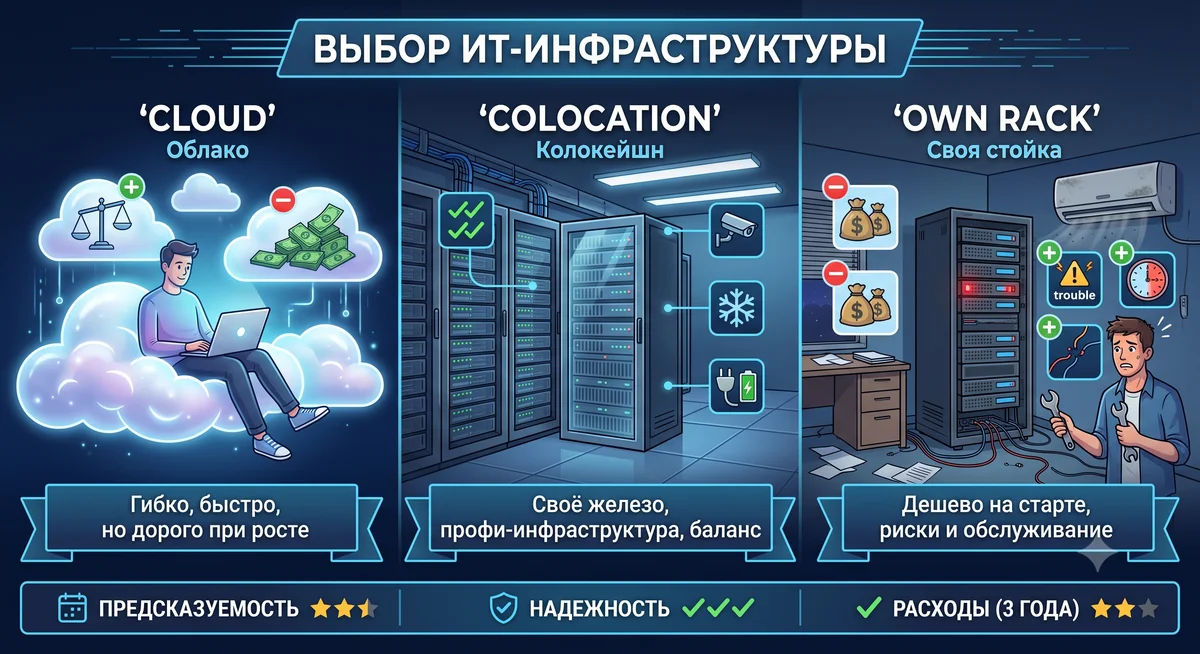
Sooner or later, every growing IT company runs into the same question: where should we keep our hardware? There are three options, and each has its own merits. Let’s break it down honestly, without a single “right answer for everyone.”
Cloud. The upside: you don’t think about hardware at all. Need resources — spin them up in a minute; don’t need them — shut them down. Perfect at the start, when load is unpredictable and the team is small. The downside shows up with growth: when servers run 24/7 for months on end, renting capacity starts costing several times more than owning your own hardware. The cloud is flexible, but you pay a premium for that flexibility.
Your own rack in the office. You buy servers, put them in a server room, and pay only for electricity. Cheap on paper. In practice, you suddenly become a data center yourself: you need a UPS, air conditioning, a backup link, physical security, and someone willing to drive in at 3 a.m. to swap a drive. One power surge or internet outage, and the whole business grinds to a halt. This option only works if you already have the infrastructure and people to maintain it.
Colocation (hosting in a data center). The middle ground. The hardware is yours, but it sits in a professional data center: guaranteed power with backup, cooling, several independent internet links, and security. You pay for rack space and the power you consume — not for “cloud magic.” Over the long run, it’s often cheaper than the cloud and more reliable than your own server room.
How to Choose
Not by the monthly price, but by three questions:
- How predictable is your load? Spiky — go with the cloud. Stable — colocation or your own hardware.
- Do you have the people and budget for your own engineering infrastructure? No — then a server room of your own is definitely not the answer.
- What happens to your business if the service goes down for six hours? If that hurts, redundancy isn’t a luxury — it’s a requirement.
In practice, many companies end up with a hybrid approach: a stable core on their own hardware in colocation, with peak and experimental loads in the cloud. That’s not betraying one approach for another — it’s just a sober calculation.
The biggest mistake is comparing only the first month’s price tag. Calculate two to three years ahead and factor in the cost of downtime. Then the choice becomes obvious.
How is your infrastructure hosted today — and have you reconsidered that decision since launch?