Data centers are surrounded by a lot of myths, and most of them cost companies real money. Let’s break down the five most persistent misconceptions — no marketing, just the facts.
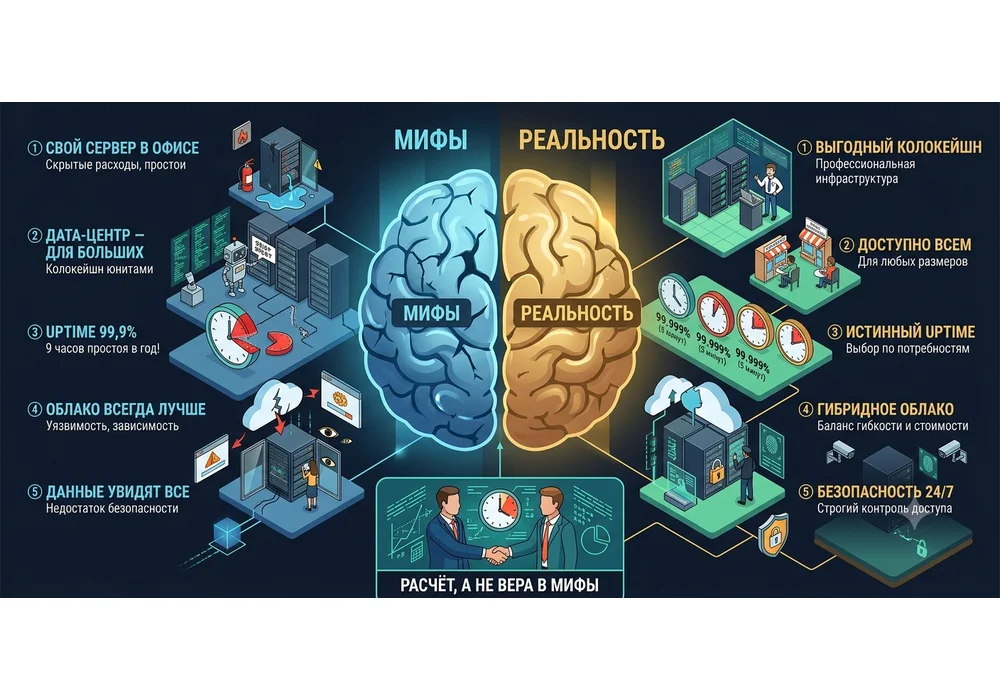
Myth 1: “Your Own Server in the Office Is Cheap”
On paper, yes: you buy the hardware and pay for electricity. But the real cost hides in everything you need around that hardware. Stable operation requires a UPS with real runtime, cooling, a backup internet link, physical security, and someone willing to show up at 3 a.m. to swap a failed drive. One power surge or a burst pipe above the server room, and your savings turn into a business-wide outage. Running your own hardware in the office only makes sense if you already have the engineering infrastructure and the people to maintain it. Otherwise, you’re paying the same price — just spread out across outages.
Myth 2: “Data Centers Are for Big Companies, Not for Us”
That used to be true: companies came to data centers for a whole hall or at least a full rack, and there wasn’t much room for a small business. Today it’s different — colocation is sold by the unit. You can install a single server and pay only for the space you occupy and the power you consume. For a small company, this ends up comparable to running your own server room — minus the hassle of power and cooling. So “we’re too small for a data center” is usually just an old habit of thinking.
Myth 3: “99.9% Uptime Means Practically Always Online”
Three nines sound impressive until you convert them into hours. 99.9% is almost 9 hours of downtime a year. 99.99% is about 52 minutes. 99.999% is roughly 5 minutes. Between “three nines” and “five nines” lies a massive gap in infrastructure cost, and each additional nine costs progressively more. Before signing an SLA, convert the percentages into minutes and honestly ask yourself how much downtime your business can actually tolerate. Overpaying for nines you don’t need is just as much a mistake as skimping on the ones you do.
Myth 4: “The Cloud Is Always More Reliable and Modern Than Your Own Hardware”
The cloud isn’t magic — it’s someone else’s data center that you connect to over the network. Outages happen there too, except you can’t manage them: when a major provider goes down, thousands of other services go down with it, and all you can do is wait. The cloud excels where load is unpredictable and you need flexibility — spin resources up in a minute, spin them down in a minute. But for stable 24/7 operation, renting capacity over a few years ends up costing more than owning your own hardware. “Modern” here means “convenient,” not “cheaper” or “inherently more reliable” — and convenience comes at a premium.
Myth 5: “Anyone Can See My Data in a Data Center”
It’s usually the opposite. Access to the server hall requires badges and biometrics, racks are locked, critical clients get dedicated enclosed cages, and everything is under video surveillance and access logs. It’s technically possible to achieve the same level in an office, but in practice few companies do — the server room often doubles as a storage closet. A professional data center is built around access control from day one, whereas in an office, security usually has to be bolted onto a room that already exists — and it’s the kind of task that rarely gets prioritized.
The Bottom Line
Expensive infrastructure mistakes almost always start the same way — a decision made by gut feeling instead of calculation. Convert those nice-looking uptime percentages into minutes of downtime. Don’t just look at the first month’s price; calculate the cost over two to three years. And honestly picture what would happen to your business during a serious outage. Look at the numbers soberly, and the myths fall apart on their own.
What misconceptions about infrastructure hosting do you hear most often?